
BCCN Retreat, 2-3 July 2026 in Tutzing
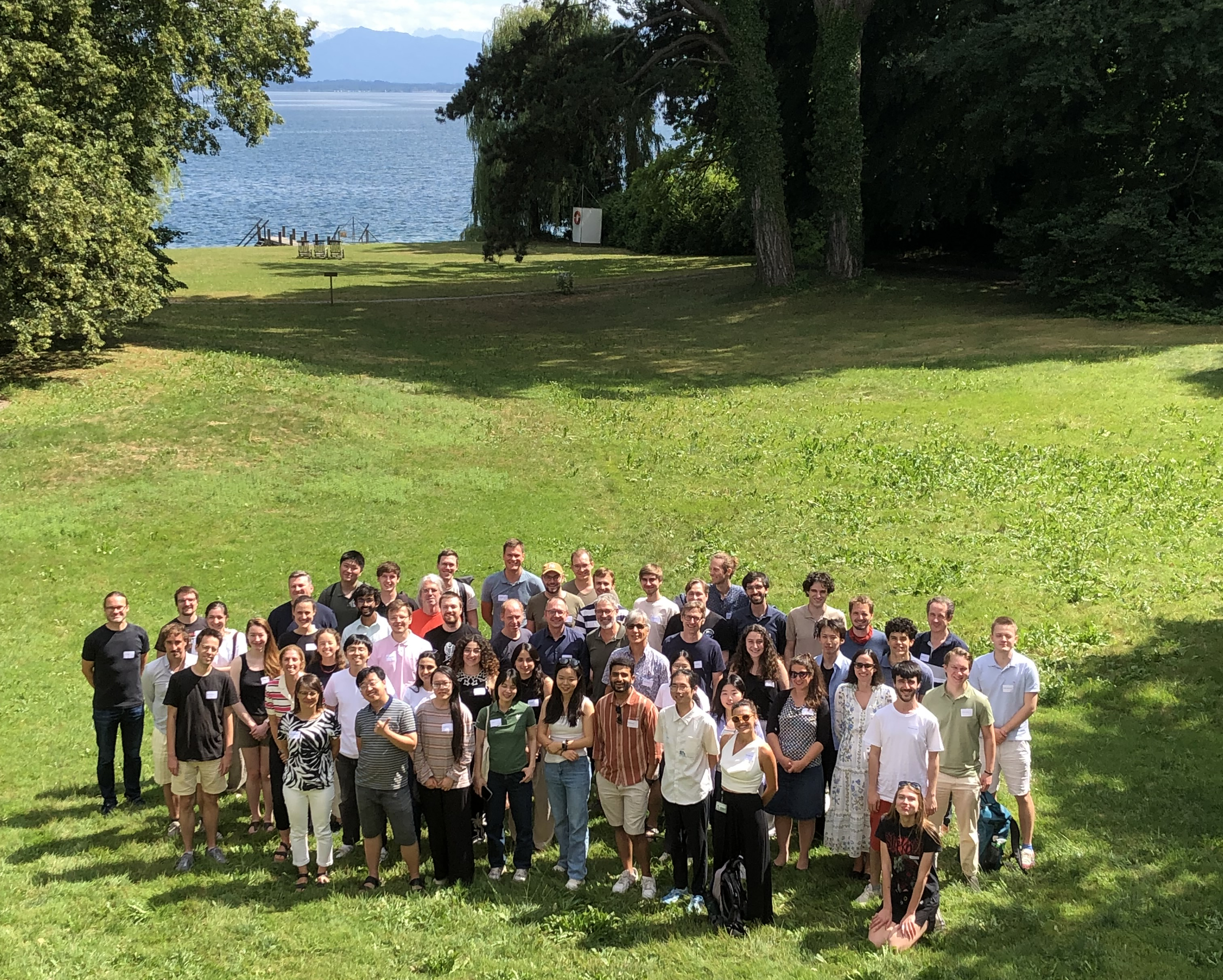
Foto: EA Tutzing
Thursday, July 2
14:00 Welcome by Andreas Herz
14:05 Lorenz Fenk - Connecting Circuits for Vision and Sleep
14:25 Elizabeth Herbert (Gjorgjieva lab) - An inhibitory interneuron handoff drives regime transitions in spontaneous activity
in the developing cortex
14:20 Siyuan Mei (Herz lab) - A multi-ring shifter network computes head direction in zebrafish
15:15 Poster Session
16:50 Lukas Hiendlmeier (Wolfrum lab) - 3D-Printed Self-folding Nerve Cuff Electrodes for Chronic Electrophysiology in Small
Animals
17:10 Julius Kraut (Hemmert lab) - Hair-bundle adaptation supplies phase alignment for mammalian outer hair cell mo-
tion amplification
17:30 Janie Ondracek - Unraveling the mysteries of sleep-related vocal deterioration in songbirds
Friday, July 3
09:00 Steffen Schneider - Towards Identifiable World Models
09:20 Felix Waitzmann (Gjorgjieva lab) - An Elephant never forgets: how Elfn1-dependent short-term plasticity shapes SST
fear response in PTSD
09:40 Franziska Knolle - When predictions go wrong: Altered predictive language processing across stages of
psychosis and its neurobiological basis
10:10 Poster Session
11:45 Eric Schulz - tba
Posters
Telemetry reveals rapid duel-driven canary song plasticity in a competitive social environmentPepe Alcami, Shouwen Ma, and Manfred Gahr
Generation of Gamma Oscillations in E/I Network: Beyond mean-field and steady-state approximationsMichael Alznauer, Abdallah Alashqar, Anton Sirota, and Caroline Geisler
How much information fits in your gaze?Simon Appoltshauser, Bastian Wiederhold, and Kay Thurley
EEG-based Auditory Attention DecodingMaryam Bajool and Bernhard U. Seeber
Auditory chunk learning: neuronal mechanisms in human frontoparietal cortex and mouse modelsSàlem Ayasreh Fierro, Xuanyu Wang, and Simon Jacob
Synaptic sub-cellular organisation in pyramidal neurons follows passive dendritic coupling structure supporting branch-specific inhibitory shuntingIngo Fritz, Na Lu, and Julijana Gjorgjieva
Anticipatory modulation as a unifying principle of sensory coding during locomotionJonathan Gant and Wiktor Młynarski
Population-level reorganization during learning amid single-neuron volatility in mouse pre- frontal cortexYu-Yang Huang, Leonie S. Mehrke, Tobias W. Bernklau, Laura Busse, and Simon N. Jacob
Geometrical Control of Spontaneous Unidirectional Cardiac ExcitationRyuya Kida, Mrinalini Gupta, Yuta Tanimura, Bernhard Wolfrum, and Tetsuhiko F. Teshima
Inferring neuronal codes for movement from natural behavior statisticsVishal Kannan, Tomás Masson, Maximilian Jösch, and Wiktor Młynarski
ISSS-GLM: A toolbox for the first level analysis of non-uniform fMRI dataViola Matten, Thomas Stephan, Thomas Eggert, and Virginia L. Flanagin
Dual pathway architecture in songbirds enables robust sensorimotor learningRemya Sankar, Atharv Suryawanshi, Nicolas P. Rougier, and Arthur Leblois
Consistent Representation Learning for Modelling Neuro-Behavioral State DynamicsTobias Schmidt, Roridgo González Laiz, Krisztián Szuppinger, and Steffen Schneider
Self-Folding Cuff Electrodes for Vagus Nerve Stimulation in a Canine ModelDefne Tüzün, Lukas Hiendlmeier, George Al Boustani, Tetsuhiko Teshima, and Bernhard Wolfrum
The lattice scales of grid-cell activity Arseniy Veselov*, Anian Kerscher*, MartArseniy Veselov*, Anian Kerscher*, Martin Stemmler, and Andreas V. M. Herz (* equal contribution)
Interplay between Egocentric and Allocentric Navigation During Rapid Spatial Memory Formation in DarknessMiao Wang, Fabian Stocek, and Anton Sirota
Mental calculation speeds surpass known limits for high-level cognitionBastian Wiederhold, Martin Stemmler, and Andreas V. M. Herz
Reproducing temporal response properties of the electrically stimulated auditory nerve fiber with a modified LIF modelJulian Wittmann and Bernhard Seeber
Nonstationary dynamics of sensory population codes during active behaviorAugustine Yuan, Hongyu Li, Steffen Katzner, Laura Busse, and Wiktor Mlynarski